
Spotlight on the 2026 Legislation updates

April marks the start of the new tax year in the UK, and with it came a number of important employment law changes. If you employ a nanny, au pair, or household staff, it's worth taking stock of what's changed and making sure your payroll, contracts, and policies are up to date. Here's everything you need to know.
National Living Wage & National Minimum Wage
The government has increased minimum wage rates across all age groups from 1 April 2026. Here's how the new rates compare to last year:
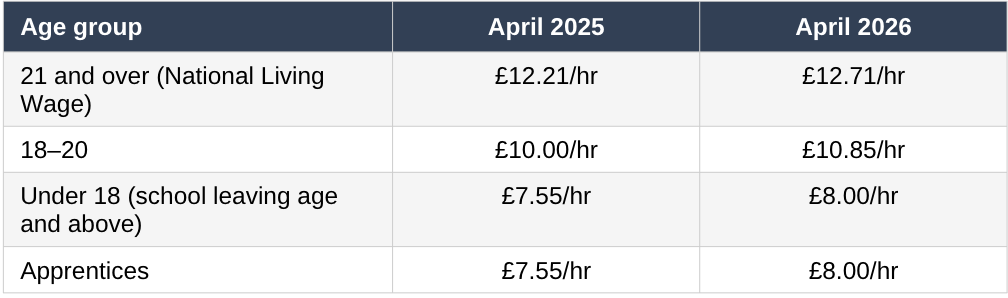
These rates are legal minimums. All nanny employers must ensure they are paying at least the applicable rate for their nanny's age. Remember: pay is calculated on basic working hours, so if your nanny works overtime or additional hours, those hours count towards the minimum wage calculation too.
The Offset Allowance (Live-in Nannies)
If your nanny lives in your home, you can apply the accommodation offset against the minimum wage. This allows employers to count a portion of the accommodation they provide towards the nanny's minimum wage entitlement.
The accommodation offset rate has increased to £11.10 per day (up from £10.66 in 2025) — that's £77.70 per week if accommodation is provided all seven days.
How it works in practice:
If your live-in nanny is over 21 and you provide free accommodation seven days a week, you can offset up to £77.70 per week from their wage. However, their total remuneration (Hourly rate plus the offset) must still equal or exceed the National Living Wage for all hours worked.
For minimum wage purposes, the accommodation offset can be added to the nanny's pay when assessing whether the National Living Wage has been met. Here's how it works in practice:
Example:
Sarah is 25 and earns £10.50 per hour (below the National Living Wage)
She works 35 hours per week
She is paid every 7 days
Her employer provides free accommodation 7 days a week
The weekly accommodation offset of £77.70 is taken into account when assessing Sarah's pay against the National Living Wage. Spread across her 35 working hours, this equates to £2.22 per hour. When added to her hourly pay of £10.50 for minimum wage calculation purposes, her remuneration is valued at £12.72 per hour, which is just above the National Living Wage of £12.71.
We'd always recommend checking your specific calculations against the government's minimum wage calculator or speaking to a payroll specialist.
Statutory Sick Pay (SSP)-What's Changed
From April 2026, two significant changes to Statutory Sick Pay come into effect:
New SSP rate
The weekly SSP rate has increased to £123.25 per week (or 80% of your nanny's average weekly earnings, whichever is lower), payable for up to 28 weeks. This is payable from the first day of sickness, a major change from previous rules.
A further significant change is that the Lower Earnings Limit for SSP has been removed, meaning more low-paid and part-time workers are now eligible for SSP.
Removal of the three waiting days
Historically, SSP was only payable from the fourth day of illness. The three "waiting days" have now been abolished, meaning your nanny is entitled to SSP from day one of any period of incapacity for work. This brings the UK more closely in line with many European countries and reflects a broader shift in employment law towards greater worker protections.
What this means for you as an employer:
Update your employment contract and sickness policy to reflect day-one entitlement
Ensure your payroll software is updated to calculate SSP from day one
Keep accurate records of all sickness absences - you'll need these if HMRC ever queries your SSP payments
Statutory Parental Pay
If your nanny is expecting a baby or becoming a parent through adoption, the rates they receive have also increased from April 2026.
Statutory Maternity Pay (SMP) & Statutory Adoption Pay (SAP)
The first six weeks remain unchanged - paid at 90% of your nanny's average weekly earnings. For the remaining 33 weeks, the flat weekly rate has increased to £194.32 (or 90% of average weekly earnings, whichever is lower).
Statutory Paternity Pay (SPP), Shared Parental Pay (ShPP) & Parental Bereavement Pay (SPBP)
All three of these have also increased to £194.32 per week (up from £187.18), or 90% of average weekly earnings, whichever is lower.
As a household employer, you pay these statutory amounts to your nanny in the usual way through payroll, and then reclaim most or all of the cost back from HMRC. If you're unsure how the reclaim process works, a payroll specialist can help.

Ready to hire the right nanny for your family?
We believe there’s a perfect match for every family if you ask the right questions. We pride ourselves on offering a matching service truly tailored to our nannies and families.
Employer National Insurance Contributions
Employer NICs increased in April 2025, and the secondary threshold, the point at which you start paying NICs as an employer, was also reduced. These changes are now bedded in for 2026, meaning:
Employer NIC rate: 15% (up from 13.8%)
Secondary threshold: £5,000 per year (down from £9,100)
If you haven't already reviewed your payroll costs in light of these changes, now is a good moment. Many nanny employers found their payroll costs rose from April 2025 - if yours didn't, it's worth double-checking your calculations.
Holiday Pay Record-Keeping
Recent changes introduced through the Employment Rights Act
What has changed?
Employers are now required to keep comprehensive records of:
• Any holiday their employee takes
• How they calculate holiday pay
These records must be kept dating back six years.
What records do employers need to keep?
The records can be kept in whatever format employers choose, but must include:
• The amount of annual leave taken (including any additional annual leave)
• Any unused holiday carried forward to the next holiday period
• Any holiday pay and how it was calculated
This is not optional. Failure to maintain adequate records constitutes a criminal offence and could result in an unlimited fine. If you don’t currently have a system for recording your nanny’s holiday, now is the time to put one in place.
What You Should Do Now
1. Check your nanny’s hourly rate against the new minimums above, factoring in their age
2. Recalculate your payroll if you’re close to the minimum wage threshold - small increases in the rate can tip a salary into non-compliance
3. Update your employment contract to reflect the new SSP day-one entitlement
4. Update your sickness policy and make sure your nanny is aware of the changes
5. Review your live-in arrangements if applicable, and recalculate the accommodation offset
6. Set up a holiday records system to comply with the new Employment Rights Act requirements
7. Speak to a nanny payroll specialist if you’re unsure - errors in minimum wage or SSP can result in HMRC penalties
A Note on Payroll
Managing nanny payroll correctly is genuinely complex, particularly with regular April updates. Many of our families use a dedicated nanny payroll service to handle PAYE, NICs, payslips, and end-of-year returns. If you're currently managing this yourself and finding it time-consuming, it's well worth exploring. We always recommend NannyTax, if you’d like to speak to someone from their team then please let us know and we'd be happy to arrange an introduction.
Last updated: April 2026. The information in this post is for general guidance only and does not constitute legal or financial advice. Employment law is subject to change - please check GOV.UK or speak to a qualified professional for advice specific to your situation.

About Kindred Nannies
The team at Kindred Nannies has over 20 years of experience helping families find a nanny in the UK and abroad. We have assisted hundreds of nannies to find a rewarding nanny job caring for children of all ages throughout London and the surrounding areas.